Client websites, our own working products and native apps. Two selected hospitality and brand concepts are clearly labelled.
LIVE PRODUCT
WE ARE MK STUDIO
A marketing studio with a personal point of view.
About this project
A complete identity and website for Madina Kabidenova’s marketing studio. The MK monogram, blue palette and scroll-controlled film lead into case studies and a callback form connected to Telegram and corporate email.
Our live JD Studio website brings web design, application development and automation into one studio identity, with motion-led storytelling, selected work and a direct project enquiry path.
An artist website for a Bangkok-based DJ performing across Asia. Live-session video, selected SoundCloud mixes and direct Telegram booking bring his sound and identity together.
Learn verbs in your browser. Keep practising on iPhone.
About this project
A language-learning website and native iPhone app for English and other languages. Search verbs, explore conjugation tables, listen to pronunciation and practise active recall with multilingual explanations. The web version works on phones, tablets and desktop browsers.
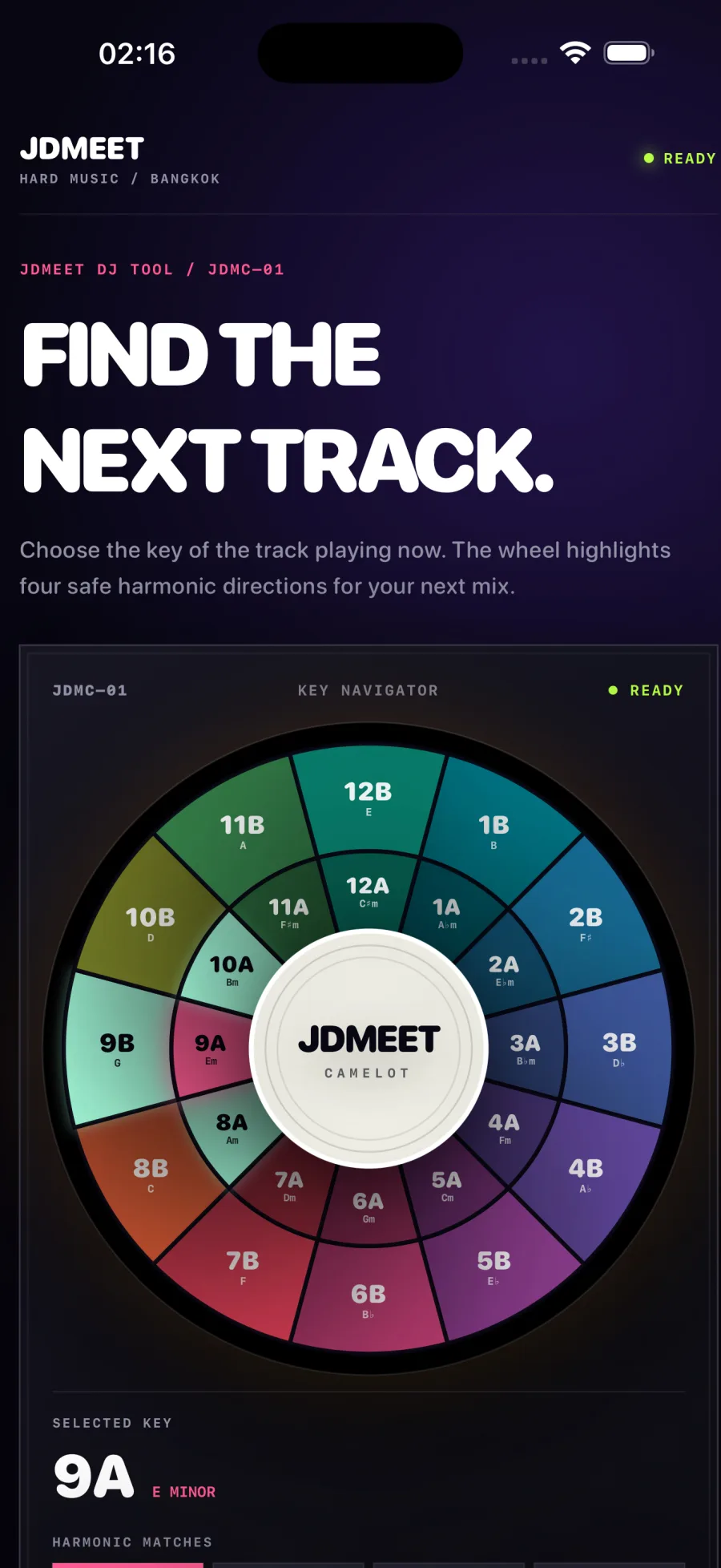
An offline harmonic-mixing companion for iPhone and iPad. Choose a key on the 24-key Camelot wheel to see compatible neighbours and relative major or minor keys. Includes haptic feedback and VoiceOver support, with no account or advertising.
A practical scope for website maintenance, monitoring, backups, lead delivery, reporting and accountable support—plus the items that need separate approval.
Map a Google Ads landing-page lead from accepted form to delivery, qualification and customer outcome with a practical search-to-sale measurement plan.
A copy-ready Google Ads landing page brief connecting search intent, ad promise, proof, qualification, tracking, lead routing and launch acceptance before design begins.
A practical framework for deciding whether to redesign the current website, rebuild the platform or improve the highest-leverage pages without replacing everything.
A realistic website redesign or rebuild timeline covering discovery, copy, development, content and SEO migration, integrations, quality assurance and launch.
Web application development typically costs $10,000–$100,000+, depending on workflows, roles, data, integrations and risk. Compare practical 2026 scope bands.
How North Growth Lab designed and built a responsive six-pad rhythm sampler with real audio, rapid retriggering and live waveform feedback for the JDMEET artist website.
Landing page or website for Google Ads? Use a six-check decision matrix, hotel and design-studio examples, and a practical brief to choose the right destination.
A transparent guide to landing-page scope, cost drivers and budgeting for businesses that need qualified leads from paid search—not a decorative one-page design.
A practical decision framework for choosing a website, web application, iOS or Android app—and knowing when the business needs a connected combination.
Compare iOS, Android and simultaneous mobile development by audience, product behavior, device requirements, release operations and commercial evidence.
How we rebuilt our studio website around real projects, distinct service pages and crawlable content, with a practical release record and clear measurement limits.
A practical scope for website maintenance, monitoring, backups, lead delivery, reporting and accountable support—plus the items that need separate approval.
This operational guide is general information, not legal, security or compliance advice. Service scope, response targets and market obligations should be documented for the actual website, technology and business. North Growth Lab is a US-registered remote company and does not claim local offices outside its registered location.
A website care plan is an ownership agreement—not a bundle of vague hours.
The useful outcome of monthly website management is not that someone appears busy. It is that a named owner watches the parts of the website that can affect discovery, trust, inquiries and day-to-day operations, then records what changed and what still needs a decision.
That agreement should identify the production website, hosting account, domain and DNS boundary, content system, forms, analytics, connected services and responsible contacts. If an item is not covered, say so. A short explicit scope is safer than an unlimited promise that nobody can verify.
Start with a baseline before accepting monthly responsibility.
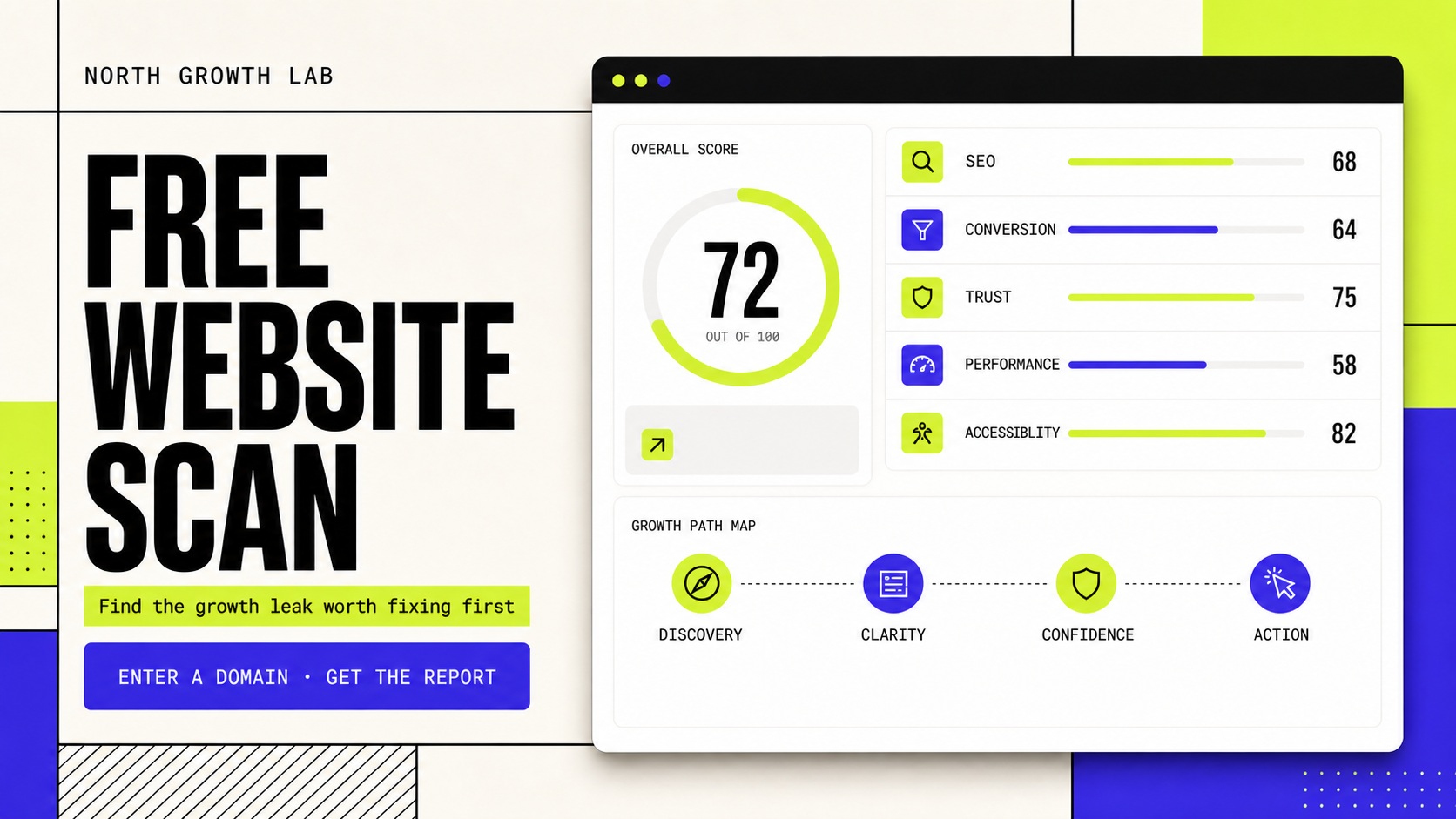
Run the free Website Growth Scan on one important public page to establish a reproducible outside-in snapshot. The result can surface discovery, clarity, confidence, action and browser-performance questions, but it cannot inspect private accounts, backup integrity, inbox delivery or internal ownership. Those require an owner-authorized review.
Record the canonical domain, critical pages, primary conversion paths and current technology owners.
Confirm who controls the domain, DNS, hosting, source code, CMS, analytics and lead destinations.
Save current uptime, performance, search and verified inquiry-delivery evidence.
List known faults, unsupported components and inherited risks separately from routine care.
Define the recurring core in observable terms.
Frequency should follow risk. A high-value booking flow may justify more frequent checks than a stable brochure page. The plan should distinguish automatic detection, human verification and actual remediation instead of calling all three ‘monitoring.’
Care area
Availability
Recurring responsibility
Monitor the agreed public routes and escalate confirmed failures
Evidence to report
Incident time, affected route, response and resolution
Care area
Backups and recovery
Recurring responsibility
Run the agreed backup schedule and test restoration at a defined interval
Evidence to report
Last successful backup, retention and recovery-test result
Care area
Updates and security
Recurring responsibility
Review supported CMS, plugin, dependency and platform updates through change control
Evidence to report
Updates applied, deferred risks and verification result
Care area
Lead delivery
Recurring responsibility
Test critical forms and reconcile browser success with controlled delivery
Evidence to report
Test date, destination, delivery result and corrective action
Care area
Measurement
Recurring responsibility
Check analytics and search instrumentation for obvious loss or configuration drift
Evidence to report
Coverage status, anomalies and decisions needed
Care area
Content and SEO hygiene
Recurring responsibility
Maintain agreed pages, metadata, links and indexable technical signals
Evidence to report
Pages changed, reason and post-change verification
Care area
Performance and accessibility
Recurring responsibility
Watch critical templates for regressions after changes
Evidence to report
Comparable checks, confirmed regression and remediation
Backups only matter when recovery is owned and tested.
A backup checkbox does not prove that the website can be restored. Document what is copied, where it is retained, how long it is kept, who can authorize a restore and which domain, secrets, uploads or external services are not included. Test recovery on a safe schedule and record the outcome.
Australian Cyber Security Centre guidance treats backups and updates as practical small-business protections. The care plan should translate that principle into the website's actual stack without claiming that routine maintenance removes every security risk.
Lead monitoring must follow the inquiry beyond the button.
Use controlled test data, label it clearly and exclude it from commercial reporting. Never create fake inquiries merely to inflate scanner or lead metrics. The useful monthly report separates test evidence from real customer activity.
Stage
Form
Question
Can a visitor submit valid data on mobile and desktop?
Failure a visual check misses
Validation or scripts block completion
Stage
Confirmation
Question
Does the visitor see what happens next?
Failure a visual check misses
A silent or misleading success state
Stage
Delivery
Question
Does the controlled test reach the intended inbox or CRM?
Failure a visual check misses
The website reports success while the message is filtered or rejected
Stage
Ownership
Question
Is a responsible person alerted and able to act?
Failure a visual check misses
The lead exists but nobody owns the response
Stage
Measurement
Question
Can the team distinguish accepted, delivered and qualified inquiries?
Failure a visual check misses
A click or browser event is mistaken for revenue
Keep routine care separate from projects and unlimited requests.
This separation protects both sides. The client knows what the monthly fee buys, and the responsible team can reserve enough capacity to keep the operational promise instead of spending it on an undefined feature queue.
Use this guide as a scope checklist, not a statement that every task is included in every North Growth Lab plan. Compare the current plans, then confirm the systems covered, change allowance, response window and separately approved costs before starting.
Usually included: bounded updates, monitoring, controlled maintenance, small agreed content changes and incident triage.
Usually estimated separately: new templates, integrations, migrations, major redesign, custom application features and large content production.
A remote team can support Australian and New Zealand clients without pretending to be locally staffed. The proposal should state the exact coverage window, holiday basis and escalation channel rather than imply a local office or 24/7 staffing.
Term
Acknowledgement
Define it as
When a named person confirms receipt and begins triage
Term
Response
Define it as
The first evidence-based assessment and next action
Term
Workaround
Define it as
A temporary safe path that restores the critical business function
Term
Resolution
Define it as
The confirmed fix, verification and incident record
Term
Coverage window
Define it as
The time zone, business hours and channels in which targets apply
Use a monthly report that supports decisions and a clean handover.
The client should retain appropriate ownership of domains, hosting, analytics and business accounts. Keep an access register, use named collaborator accounts and document a fair exit process for credentials, source, backups and operational notes. A durable care relationship should come from accountable value—not from making departure technically difficult.
Availability incidents and confirmed resolutions.
Backup status and the latest recovery-test evidence.
Updates, changes, verification and deferred risks.
Controlled lead-path tests and delivery outcomes.
Search, analytics, performance or accessibility anomalies worth a decision.
Next priorities, owner and proposed scope outside the care plan.
Website care plan FAQ.
What is the difference between website hosting and a website care plan?
Hosting provides the infrastructure that serves the website. A care plan defines human and automated responsibility around monitoring, recovery, updates, lead delivery, measurement, content hygiene and incidents. Some providers combine them, but the responsibilities and account ownership should still be explicit.
How much website maintenance should be included each month?
Define recurring tasks and bounded change capacity from the website's actual risk and update frequency. Avoid an unlimited promise. New features, major design work and migrations should normally use a separate estimate and approval.
Can a website scanner replace monthly maintenance?
No. A public scan is a useful baseline and regression signal, but it cannot own private accounts, test backup recovery, verify every lead destination or respond to incidents. Use it to prioritize the owner-authorized operational review.
Should the agency own the client's domain and hosting accounts?
The client should normally retain appropriate ownership and grant named, minimum-necessary collaborator access. The agreement should document responsibilities, billing, recovery access and a clean handover process.
Can North Growth Lab support Australia and New Zealand?
Yes. North Growth Lab agrees explicit coverage windows for Australian and New Zealand business hours. It does not claim a local AU or NZ office; response scope and time zones are documented in the proposal.